
Lombard Neighbor Records by Source
A public block search can identify parcel boundaries, PINs, tax-roll owner names, and taxing districts. It cannot reliably name every person present. DuPage GIS provides the block shape, the assessor supplies the current certified parcel detail, the Recorder documents ownership transfers, and election records follow strict identity and use rules. Village and local-history sources add civic context without becoming household directories.
| Source | What It Shows About a Block | Access |
|---|---|---|
| DuPage GIS parcels | Adjacent polygons, PINs, owner labels, map layers, and buffer results | Public viewer with TXT, CSV, PDF, XLS, and XLSX export |
| Assessor parcel cards | Owner or billing name, situs, tax entities, sales, and legal description | Public Property Records Search |
| Recorder documents | Deeds and other instruments for each selected PIN | Online index and image coverage; older office research |
| Voter records | Individual identity/address match or lawful data products, not a block browse | Lookup or Election Division request under purpose and redaction rules |
| Village civic pages | Public board members, organizations, and event sponsor process | Public pages; no household roster |
| Library and Society history | Dated newspapers, directories, photos, and oral-history clues | Online, library, or research request |
Read the source column before interpreting a name. An assessor owner or billing name is a tax-roll fact, not proof of current occupancy. A board roster proves public civic service on a stated date, not residence on a specific block. Even a directory entry is only a dated clue. The strongest conclusion is often narrow: a named owner was linked to a parcel in the certified roll, or a person appeared in a dated public record.
Use Lombard's 250-Foot Parcel Buffer
The DuPage Parcel Viewer guide documents a Buffer tool that defaults to 250 feet. It can start from a parcel search result, one feature in a map popup, or all features in that popup. Enter a different distance only when the research question needs it. A tight buffer is far more useful for immediate neighbors than a broad citywide export.
The viewer also supports address, PIN, subdivision, intersection, point, and polygon searches. A shape search is capped at 1,000 parcels. Once the selected area looks right, export the result to TXT, CSV, PDF, XLS, or XLSX. Save the buffer distance and capture date with the file so another person can reproduce the same block set.
The manifest image from the official Lombard Associations and Memberships page shows the civic source that can supplement parcel facts:
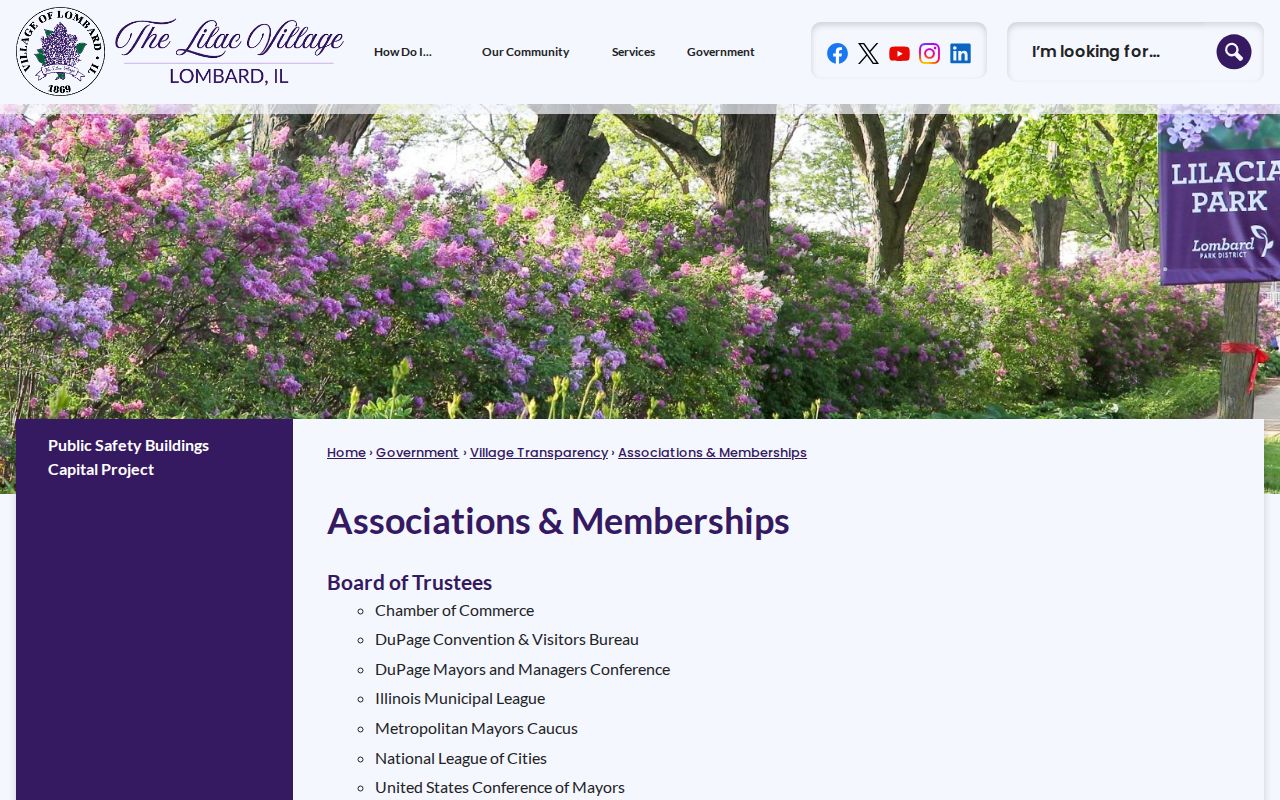
It names civic and professional organizations connected with Village work, but it does not supply a directory of homes around a parcel.
Map Lombard Neighbors Parcel by Parcel
Move from map geometry to official parcel detail one PIN at a time. The GIS layer carries separate BILL* and PROP* fields. The former are billing or mailing data; the latter describe the property, or situs, address. Preserve both rather than substituting one for the other.
- Search the known address in the DuPage Parcel Viewer and confirm the selected parcel's street and PIN.
- Apply the buffer or click the immediately adjacent parcel polygons. Export the small result set.
- Open each PIN in the DuPage Property Records Search and record the owner or billing name, situs, legal description, and tax entities.
- Use the Recorder only when a deed or ownership history is relevant. Confirm the legal description in the instrument.
- Date the findings. Do not turn owner names into claims about all occupants.
A parcel at Lombard's edge can show the Village, York Township, school, library, park, fire, and other district entities together. Nearby parcels may differ across a district line. For a whole named road rather than the immediate block, switch to the Lombard street directory workflow.
Lombard Block Boundaries Add Context
Tax entities on the assessor card show which public bodies serve a parcel. They can explain why two close Lombard addresses have different school, park, library, fire, township, or municipal lines. Those fields are district facts. They do not reveal a person's private affiliations or prove that the billing owner lives on site.
Use the actual PIN card at an edge rather than assuming that ZIP 60148, a Lombard mailing label, and the Village boundary are identical. The GIS property ZIP, assessor situs, billing address, and deed legal description are four distinct location keys. The parcel itself resolves which government and district fields apply.
Note: A shared postal city does not guarantee shared Village or special-district boundaries, even when two Lombard addresses appear on the same block.
Lombard Voter Records Are Not Block Lists
The DuPage voter lookup is built to match an elector to identity or address details and return election information. It is not a free-form directory for browsing every voter on a street. The address route asks for house number, street name, city, and optional direction or suffix. Identity alternatives involve birth date and protected credentials that should never be collected for neighbor research.
Illinois voter-file products follow purpose, affidavit, redaction, and fee rules. A lawful request may involve electronic data, printed pages, labels, maps, or a certified voter record. Redacted fields and use limits apply, and request details may themselves become public. If the goal is civic study, ask the Election Division for precinct maps or the correct data product instead of assembling nearby voters through repeated lookups.
The official DuPage vote-by-mail lookup appears in the captured image below:
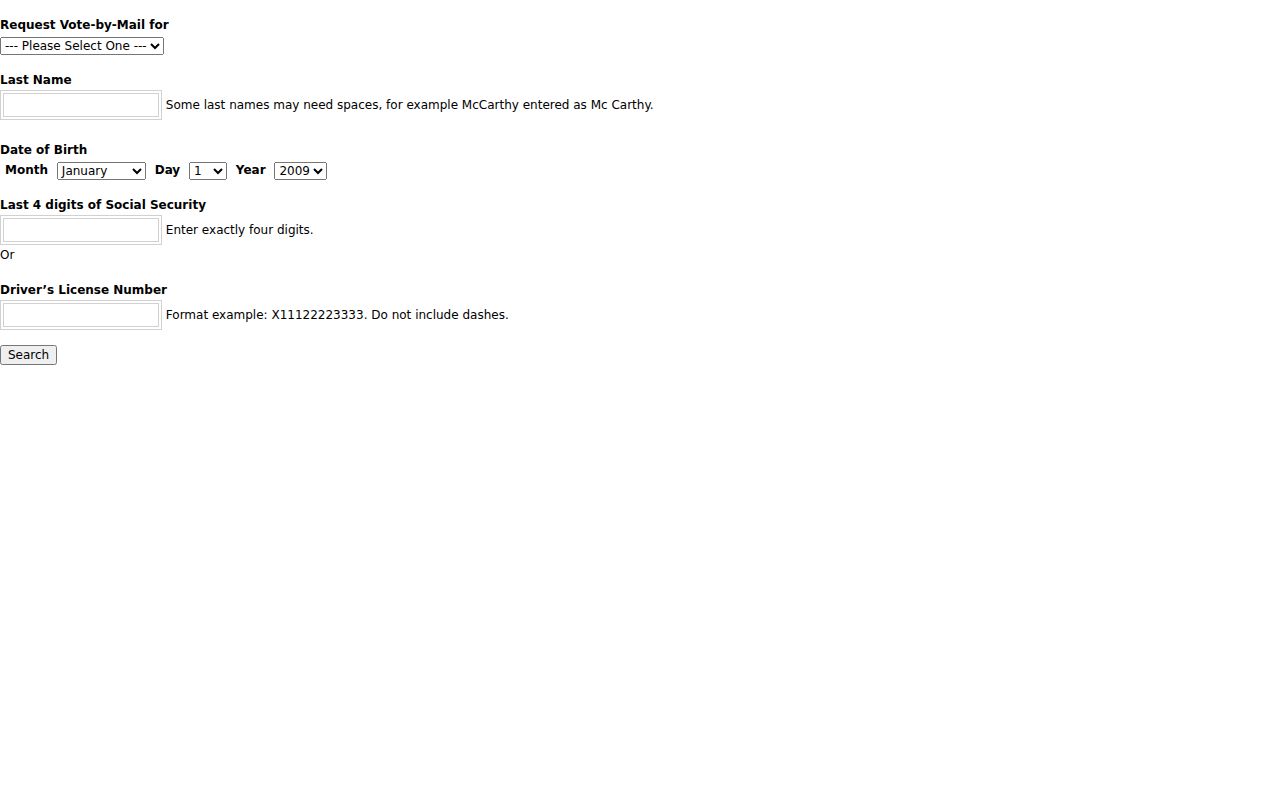
That screen is a personal request or status route, not a source for identifying Lombard neighbors around an address.
Lombard Neighbors in Civic Records
The Village does not publish a citywide neighborhood association or HOA directory. Its official pages instead name the Lombard Area Chamber of Commerce, Yorktown Merchants' Association, municipal associations, Village boards, committees, and commissions. These sources can identify a public role or civic connection on a stated date. They cannot fill in a household roster.
| Community source | Useful fact | Directory limit |
|---|---|---|
| Associations and Memberships | Named civic, business, and professional organizations | Primarily Village staff and department memberships |
| Boards, Committees and Commissions | Public participants, agendas, and meeting context | Not neighborhood membership |
| Block Party application | Event sponsor process for a road closure | No public roster or searchable archive located |
When a subdivision or HOA name is unknown, use the parcel's plat or subdivision field, or ask Village Community Development. Do not invent a neighborhood label from a real-estate listing or a loose mailing-area name.
Compare Lombard Neighbor Lookup Sources
Official records are narrower than commercial neighbor tools, but their source and custodian are visible. Commercial compilations can merge old addresses, relatives, and phone data without showing how each match was made. They should never displace the parcel card, recorded deed, or dated civic record.
| Source type | Strength | Main limit |
|---|---|---|
| Official parcel and deed records | Defined fields, date, PIN, legal description, named custodian | Owner and instrument data do not identify every occupant |
| Official civic and election sources | Clear public purpose and current office route | Purpose limits, redactions, and no general block roster |
| Commercial compilations | May combine many public and licensed sources | Stale merges, unclear provenance, cost, and changing suppression rules |
Correct an error at the official custodian first. Removing a commercial copy does not change the assessor, Recorder, voter, court, or newspaper source from which it may have been drawn.
Historic Lombard Neighbors Need Dates
The 1924-25 McDonough directory lists Lombard residents age 16 and older and may include a spouse, occupation, residence, business tie, or telephone suffix. Newspapers in Advantage Archives, Helen Plum microfilm, Historical Society photographs, and oral histories can add people or events from the same block. Always date the item and verify OCR against the page image.
The old directory also names churches, a graded school, lodges, and the post office at St. Charles Road and Main Street. Such institutions are leads for public histories, anniversary books, or archive questions, not proof of a person's membership. No complete current Lombard church, alumni, yearbook, lodge, or neighborhood roster was located in the official sources.
Protect Privacy of Lombard Neighbors
Public parcel records may show an owner name, property address, billing fields, legal description, and tax entities. They do not open utility accounts, delivery records, full voter identifiers, sealed cases, or a list of every person inside a home. Avoid filling those gaps with guesses about family ties, occupancy, or private conduct.
The Illinois Address Confidentiality Program gives eligible survivors a substitute address for new state and local public records. It cannot remove older records or guarantee confidentiality in property records. ACP voters use the program's voter application and vote by mail so local election authorities can protect their information from public disclosure.
Lawful use. Use block records for civic awareness, genealogy, reconnecting, or personal safety. Never use them to watch, intimidate, harass, expose, or harm Lombard neighbors.
If a source record is wrong, save its URL and a dated capture, then ask the named custodian about correction. For an immediate protected-address concern, contact the Attorney General's ACP route before repeating a confidential location in any request.