
Holdings for Lombard City Directories
The confirmed printed directory is one part of a larger historical shelf. Its catalog title and cover disagree by one year, so both labels should travel with a citation. Newspaper runs use open-ended catalog notation, while oral histories and cemetery material rely on collection access rather than a name-only public index.
| Collection | Years or creator | Repository | How to use it |
|---|---|---|---|
| DuPage County directory with Lombard section | Cover 1924-25; catalog 1925-26; McDonough & Co. | Illinois Digital Archives, Naperville Heritage Collection | Free public-domain scan; Lombard listed at printed page 595 |
| Lombard news | 1912-19uu catalog notation | Helen Plum Library microfilm | Ask staff to confirm the actual end year |
| Lombard Spectator | 1927-9999 catalog; digitized 1995-2012 batch | Helen Plum and Advantage Archives | Search OCR, then verify the page image |
| Lombardian and Lombard Suburban Life | Exact complete runs not stated | Library and Historical Society partnership | Search Advantage Archives and ask about microfilm gaps |
| Voices of the Past | Oral histories recorded in the 1970s | Lombard Historical Society | Collection access while digitization continues |
| Federal census | Through 1950 under the 72-year rule | NARA and library databases | Pair households with the nearest directory edition |
No official complete Lombard run for Polk, reverse directories, old telephone books, yearbooks, or Sanborn maps was located. That is a reason to ask Helen Plum Library and the Historical Society for an item-level check, not a reason to fill missing years with assumptions.
Open the Lombard McDonough Volume
The Illinois Digital Archives scan contains 1,188 pages. Metadata calls it DuPage County Directory, 1925-26, but the scanned cover reads Du Page County Illinois Directory 1924-1925, names McDonough & Company at 416 South Dearborn Street in Chicago, and carries a 1924 copyright. The cover is the best evidence for the printed edition year.
Open the official scan before searching the OCR:
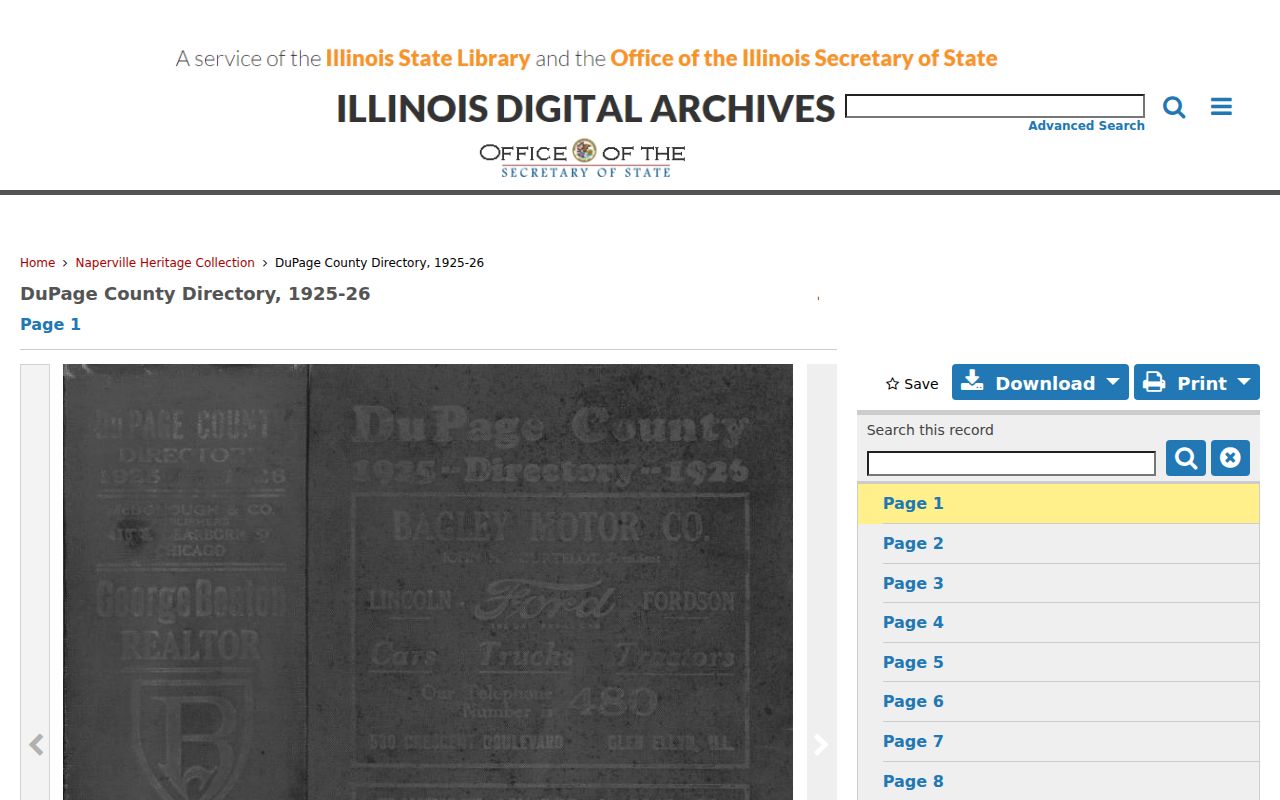
The image confirms that the city directory is a scanned volume rather than a modern people database. Use the table of towns to reach Lombard at printed page 595, with resident entries beginning around page 598.
The book combines city directories, a rural section, and a business and professional buyers guide. Its introduction also points to county officials, courts, townships, schools, village officials, lodges, and clubs. That context can identify which government or community name a resident would have recognized at the time.
Decode a Lombard Directory Line
The Lombard heading says “Population 2544” and describes an alphabetical list of residents aged 16 and older. A line may include surname, given name, a spouse in parentheses, occupation or business, a residence, and a telephone number. Not every entry contains every field, and the inspected pages do not show a consistent owner or renter mark.
| Name form | Initials and full names vary; test both in OCR and nearby pages. |
|---|---|
| Parentheses | Often identify a spouse or household name, such as Bernard Abeler (Ada). |
r | Introduces the residence address or locality, not a claim of property ownership. |
| Widow notation | “Mrs (Wid Theodore)” gives a family-history lead that needs another source. |
| Phone suffix | Period numbers can end with a letter, such as 45-M or 88-J. |
| Business place | An employer, business address, or “Chgo” can point outside Lombard. |
Sample entries include a piano tuner on Stewart Avenue, a manager with a Chicago business connection on North Main, and Alexander Lumber Co. on Charlotte Street. These examples show the fields, not present-day facts. OCR can lose initials, punctuation, and phone suffixes, so cite the image page.
- Directory entry
- A dated publisher's line about a person or business, not a government certificate.
- Criss-cross directory
- A later directory arranged by address or phone rather than surname; no exact Lombard run was confirmed.
- Abbreviation key
- The publisher's explanation of shortened terms, which should be checked before interpreting a line.
Search Lombard Library Newspapers
Helen Plum Library's Genealogy and Local History collection is at 411 S. Main Street, Lombard, with phone 630-627-0316. Its local materials include newspapers on microfilm, books, periodicals, passenger lists, directories, and indexes. Genealogy librarian David Gogo is listed at extension 405. Ancestry is available only inside the library, while HeritageHub, Fold3, maps, regional histories, and discovery tools have their own access terms.
The Advantage Archives partnership searches digitized pages of the Lombard Spectator, Lombard Suburban Life, and Lombardian. Search a surname with an address, business, school, or club, then cite the publication, date, and page. OCR is a lead. The scan is the evidence.
A November-December 2024 library activity report documents a second batch of 138 digitized microfilm reels, including Lombard Spectator issues from January 1995 through February 2012. This adds a verified window, but it does not turn the catalog's “9999” notation into a promise of a continuous run.
Lombard Historical Society Collections
The Lombard Historical Society Archives & Collections adds photographs, textiles, Little Orphan Annie memorabilia, collection descriptions, newspaper access, and Voices of the Past oral histories. These sources can connect a city directory name to an image, civic event, business, or spoken memory.
See the Society's online collection surface before planning a request:
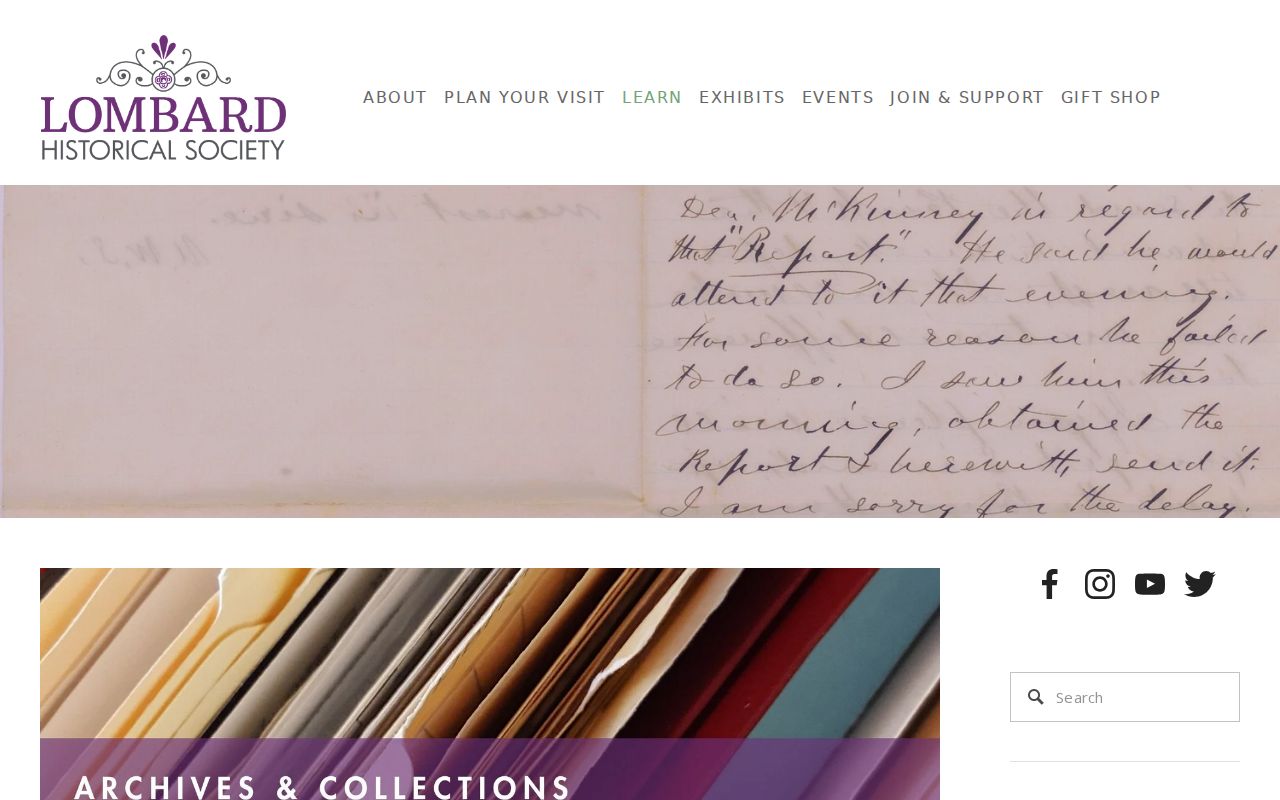
The page provides the human fallback when an item has not been indexed online. A standard research request costs $20, members receive one free request each year, and ordinary turnaround is three to six weeks. On-site research requires a pre-approved appointment. The Society states that students, scholars, and researchers do not pay the research fee.
Include names, dates, known sources, and a focused question. Photocopies depend on condition and copyright. Those limits are especially important for oral histories, photographs, and cemetery material that may have collection-level descriptions without a public name search.
Trace Lombard Households Across Years
A city directory line becomes stronger when paired with a released federal census and a dated local paper. Lombard was incorporated in 1869, so earlier residents may appear under DuPage County, York Township, a church, a cemetery, or another local label. Keep that boundary context with the record.
- Transcribe the 1924-25 entry exactly, including initials, parentheses,
r, phone suffix, street, and business place. - Search the same household in the 1920 and 1930 federal censuses. Test spouse names, initials, and alternate spellings.
- Use the local newspaper archive between census years. Pair every OCR hit with the scanned issue and page.
- Check deed, tax, marriage, death, probate, and cemetery sources only for the question each can answer.
- When the trail stops, search the spouse, former surname, business, obituary, and nearby directory entries before concluding that the household moved.
A disappearance can mean relocation, death, a changed listing, an omitted year, or a source gap. It does not prove any one event. Later federal census schedules remain closed under the 72-year rule, so newspapers and local collections are the practical bridge beyond 1950.
Lombard Cemetery Predates the Village
Lombard Cemetery began as an 1851 burial ground, before village incorporation. A land donation followed in 1864, and the ground was laid out in 1870. Later association and maintenance changes help explain why burial information may sit with the Society, village-linked material, church sources, or county records instead of one present-day portal.
The Historical Society links a cemetery book, but no complete public interment search was found. Treat the book or a staff response as a dated source, then compare death records, obituaries, probate, and family notices. This is a useful reminder that a Lombard city directory is only one slice of a person's life.
Note: Records from before 1869 may use county, township, church, cemetery, or rural locality labels instead of Village of Lombard.
When Lombard Directories Fall Short
Helen Plum Library does not publish a complete year-by-year directory, phone-book, reverse-directory, yearbook, or funeral-home inventory. The Historical Society likewise offers collection and request routes, not a complete resident index. Ask a precise question: which publisher, year, street, title, or format is available?
For broader county history, the IRAD DuPage guide identifies local-government series at Northern Illinois University. Cataloged examples include board minutes from 1839-1959 and marriages from 1839-1932. Name both the series and repository when citing a result. No verified courthouse disaster or lost decade was found, so known access and coverage gaps should not be explained with an invented destruction story.
Modern size also changes the search. The 1924-25 directory printed a population of 2,544, while the 2020 Census counted 44,476 Lombard residents. That contrast explains why the historic volume can feel compact and why current property, election, and postal records are split among several custodians. Use the Lombard street directory workflow when the task shifts from an old printed entry to a present parcel.
Institution names can supply another bridge. The McDonough pages name Sacred Heart, St. John's Evangelical Lutheran, First Congregational, Methodist Episcopal, Lombard Graded School, lodges, and local officials. Contact the named institution or the genealogy librarian about surviving registers, anniversary books, programs, or school material. No complete public church, alumni, yearbook, or lodge roster was confirmed, so membership must never be inferred from a nearby address or a mention in the city directory.